Lead Generation for Small Businesses in Mauritius: Ways to Get Better Leads
Lead generation means getting interested people to raise their hand: send a message, call, fill in a form or walk in and ask. For a small business in Mauritius, most leads come from Facebook and Instagram, WhatsApp, Google Maps and word of mouth. But getting leads is only half the job. The other half is the follow-up: reply within minutes, follow up on day 1, day 3 and day 7 with something useful, and track every lead until it becomes a sale or a clear no.
THE QUICK ANSWER
- Know your sources: Facebook and Instagram, WhatsApp, Google Maps, referrals, walk-ins.
- Reply within minutes during opening hours. Speed beats everything else.
- Follow up three times: day 1, day 3 and day 7, each with a reason to reply.
- Track every lead with its source, stage and next step.
- Fix the follow-up before buying more leads.
A warning first. When sales are slow, most businesses look for more leads: more ads, more posts, more boosts. Often the leads are already there, and the follow-up is losing half of them. More ads won’t fix a leaking bucket.
When a business wants to hire me as a consultant, the first thing they ask is: How do I get more leads? The right question should be “How do I close more leads?” Having more leads is not a guarantee that you will make more money as a small business.
In this guide
What lead generation means for a small business
A lead is a person who has shown interest and given you a way to reach them back. Lead generation is everything you do to create those leads; lead follow-up is everything you do to turn them into customers. Together they form a simple marketing funnel:
| Stage | Who they are | Your job |
|---|---|---|
| Audience | People who see your posts, ads or shop | Get noticed by the right people |
| Lead | Someone who messages, calls or fills in a form | Reply fast and ask the right questions |
| Qualified lead | Someone with a real need, budget and timing | Send the offer or quote, then follow up |
| Customer | Someone who has paid | Deliver well, then ask for a review and a referral |
In a marketing strategy, getting leads belongs to visibility, and turning them into sales is the conversion stage. Most small businesses work hard on the first and leave the second to chance.
I put a lot of emphasis on QUALIFIED leads. This means that they are not contacting your business just for the sake of it but actually have a real need and you as a business has the potential to fulfil that need. Some lead generation processes require lead nurturing. You need to make people want to do business with you. If it happens before they ever contact you, that’s great for your business. But sometimes, you will need to put an extra effort to earn their money.
Where leads come from in Mauritius
| Source | How the lead arrives | What to set up |
|---|---|---|
| Facebook and Instagram | Messages, comments, lead forms from ads | Inbox automations and a clear call to message. See how much Facebook ads cost |
| Direct chats, often from your posts, ads or shop sign | WhatsApp Business with labels and quick replies. See WhatsApp Business for small businesses | |
| Google Maps and search | Calls, website clicks, direction requests | A complete Google Business Profile. See Google My Business for shops |
| Referrals | A friend or past customer sends someone | Ask happy customers, and thank them |
| Walk-ins and phone | People visit or call the shop | Write every enquiry down, not just online ones |
| Website forms | An email or form notification | Send it to a phone someone checks every hour |
Check yours: Do you know which two sources brought most of your customers last month? If not, start asking every new customer “How did you hear about us?”
Speed: reply within minutes, not hours
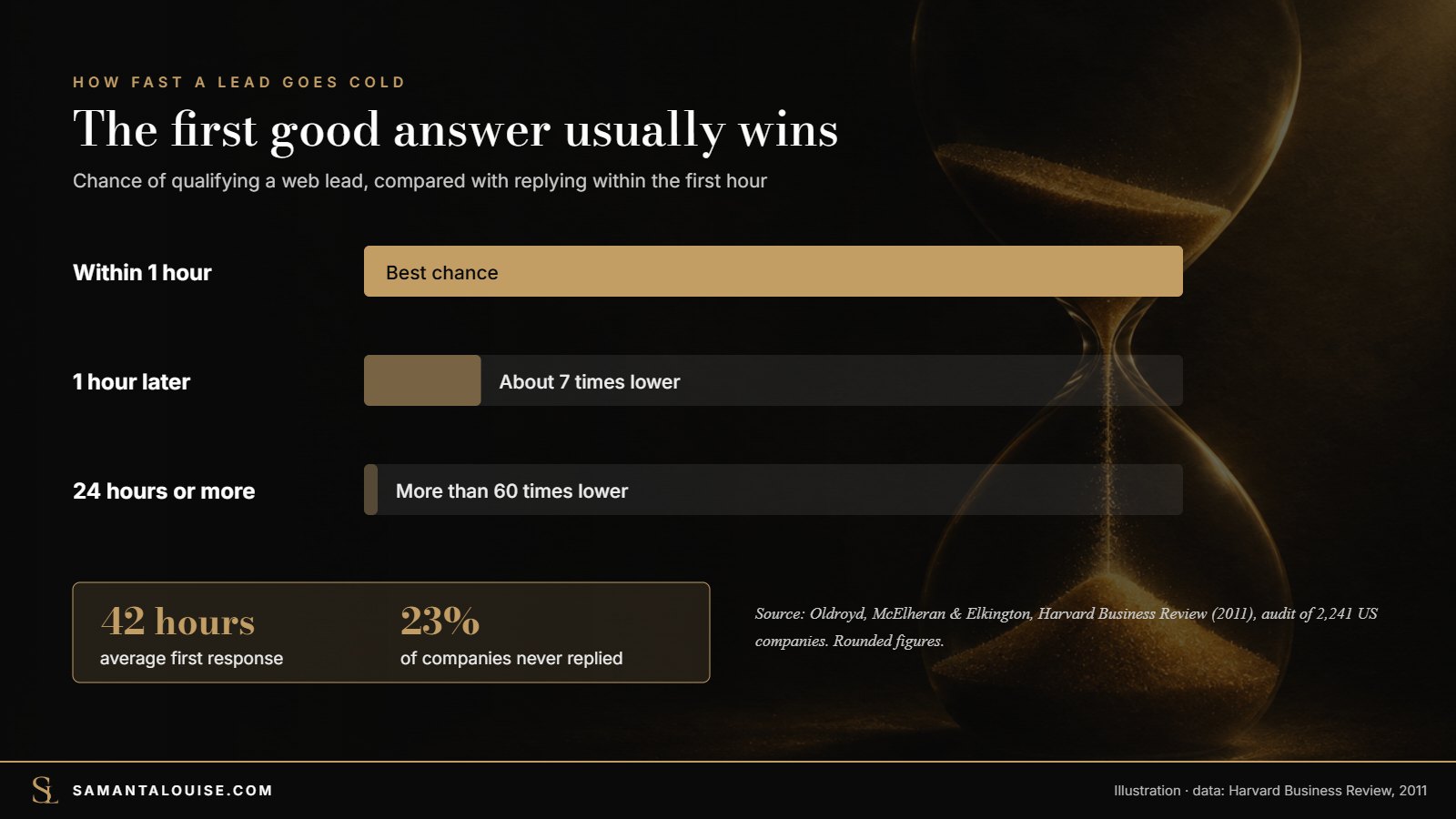
The best-known research on this comes from the United States, but the lesson travels. In 2011, Oldroyd, McElheran and Elkington audited how 2,241 US companies answered web leads, in a study published in the Harvard Business Review. Companies that tried to contact a lead within an hour were nearly seven times as likely to qualify it as those that waited even one hour longer, and more than 60 times as likely as those that waited 24 hours or more. The average first response took 42 hours, and 23% of companies never replied at all.
An earlier study by Oldroyd and InsideSales.com, covering more than 15,000 web leads, found that calling within 5 minutes instead of 30 raised the odds of reaching the person 100 times (as summarised in this review of the original speed-to-lead studies). Both studies are about phone calls to web leads, more than a decade ago, and some authors were linked to a sales software company. But in Mauritius, where the customer who messages you is often messaging the shop next door too, the first good answer usually wins.
How to make it realistic: set an instant reply, put one named person in charge of the inbox during opening hours, and turn on notifications on their phone. Outside opening hours, an away message that says when you will reply is enough.
A 3-step follow-up sequence that does not feel pushy
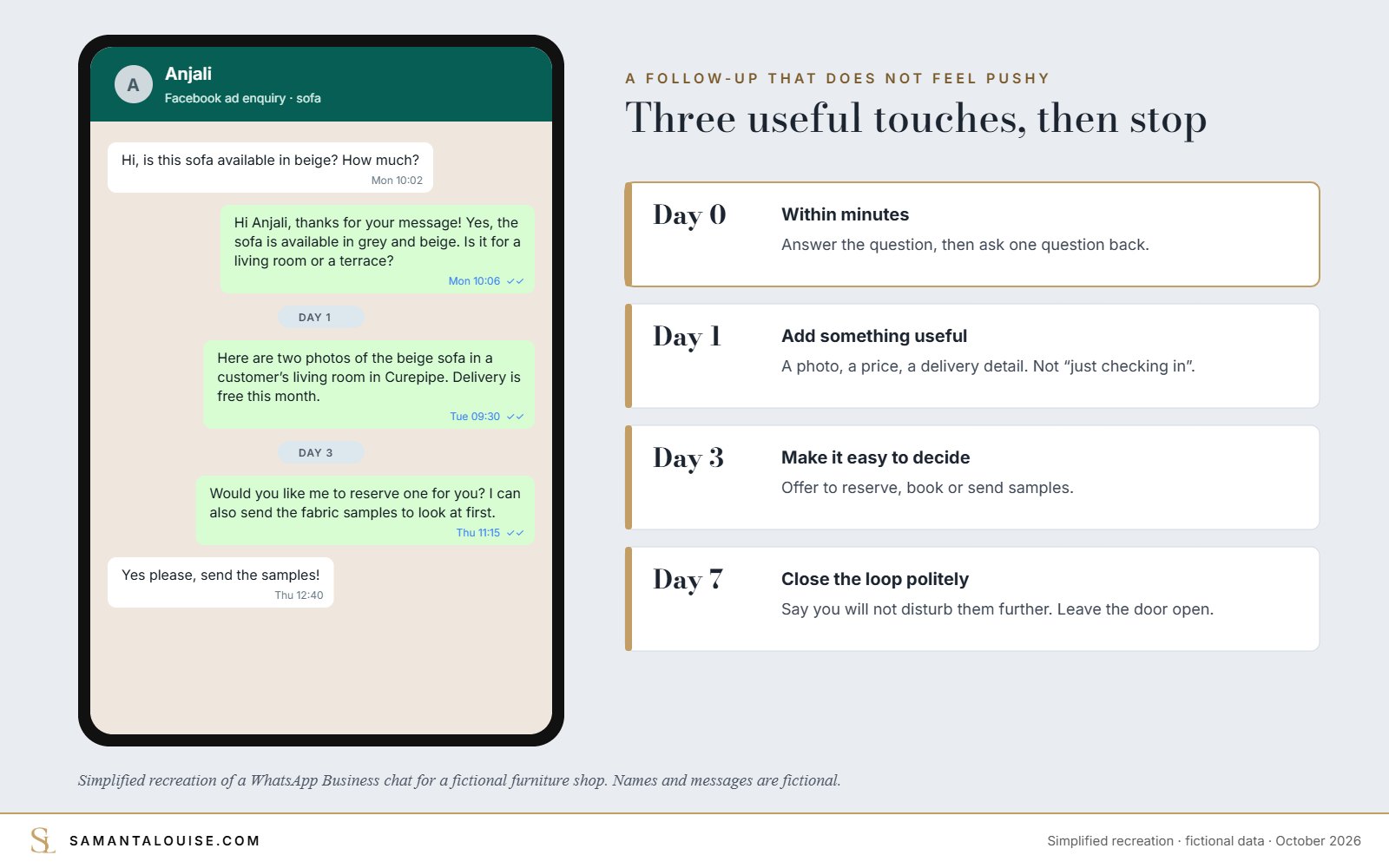
Many enquiries go quiet after the first reply. That is normal: people get busy, compare prices or wait for payday. A short, polite sequence brings many of them back. Each message must give a reason to reply: new information, a photo, an answer to a likely question, or a simple choice.
| When | Purpose | English | Français |
|---|---|---|---|
| Day 0 (within minutes) | Answer and ask one question | “Hi Anjali, thanks for your message! Yes, the sofa is available in grey and beige. Is it for a living room or a terrace?” | “Bonjour Anjali, merci pour votre message ! Oui, le canapé est disponible en gris et en beige. C’est pour un salon ou une terrasse ?” |
| Day 1 | Add something useful | “Here are two photos of the beige sofa in a customer’s living room in Curepipe. Delivery is free this month.” | “Voici deux photos du canapé beige chez une cliente à Curepipe. La livraison est offerte ce mois-ci.” |
| Day 3 | Make it easy to decide | “Would you like me to reserve one for you? I can also send the fabric samples to look at first.” | “Souhaitez-vous que je vous en réserve un ? Je peux aussi vous envoyer les échantillons de tissu d’abord.” |
| Day 7 | Close the loop politely | “I won’t disturb you further. If you need anything later, just reply to this message. Have a lovely week!” | “Je ne vous dérange pas davantage. Si vous avez besoin de quoi que ce soit plus tard, répondez simplement à ce message. Belle semaine !” |
Fictional example for a furniture shop. Adapt the words to your business, and write in the language the customer used.
How many follow-ups? You may have read that “80% of sales need five follow-ups”. That figure is repeated everywhere, but a 2026 investigation traced it to a 1942 survey with fewer than 40 respondents that no longer exists. Three thoughtful follow-ups after your first reply is a sensible rule for a small business. Then stop, and respect a “no”.
Check yours: Pick five enquiries from last week that went quiet. Did each one get at least one follow-up?
Track every lead until it is won or lost
You cannot fix what you cannot see. Keep every lead in one place, a simple Google Sheet or a CRM, with its date, source, stage, next step and next step date. The CRM guide for small businesses includes a free sheet template.
Then, once a week, look at four numbers:
| Number | What it tells you |
|---|---|
| Leads this week, by source | Which channels are working |
| % answered within 15 minutes | Whether speed is costing you sales |
| % of leads that became customers | Whether your offer and follow-up work |
| Cost per lead and per customer | Whether your ads pay for themselves |
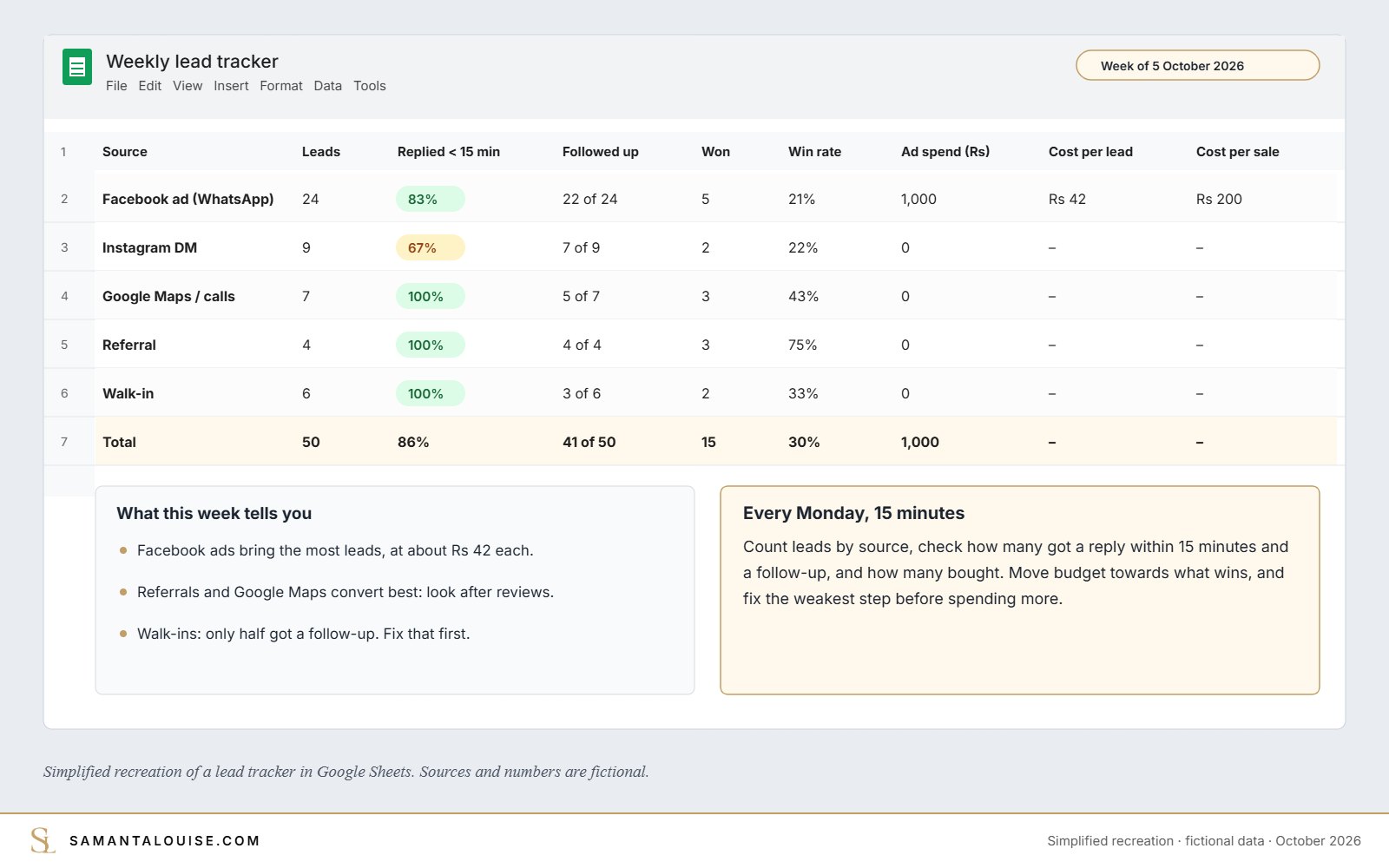
In the WhatsApp-enquiry campaigns I have run, a lead has cost about Rs 15 in ad spend. That only becomes a good number if enough of those leads turn into customers, which is why the follow-up matters as much as the ad.
When follow-ups start slipping because there are too many leads to remember, a CRM with automatic reminders and messages helps. HighLevel, the CRM I set up for clients, can send the day 1, day 3 and day 7 messages for you and remind your team when a lead needs a personal touch. Book a call if you want it set up for your business.
Why more leads alone will not grow your sales
Here is the pattern. A business runs ads, gets 60 enquiries in a month and makes six sales. It concludes that the ads are not working, and either stops advertising or doubles the budget.
Neither fixes the real problem. If 30 of those 60 leads waited hours for a reply, and 20 never got a follow-up, the business did not have a lead problem. It had a follow-up problem. Doubling the leads doubles the waste. Find your weakest stage first: if leads arrive but do not buy, fix the replies, the offer and the follow-up before you spend another rupee on ads.
The five stages of a small-business marketing strategy help you see where the bucket is leaking.
Check yours: Out of your last 20 leads, how many got a reply within 15 minutes, and how many got at least one follow-up?
Frequently asked questions
What is lead generation?
Lead generation is everything a business does to get interested people to make contact, such as sending a message, calling or filling in a form, so you can follow up and turn them into customers.
What is the best way to generate leads for a small business in Mauritius?
For most small businesses: Facebook and Instagram content and ads that invite people to message you, a complete Google Business Profile, WhatsApp Business, and referrals from happy customers. Then make sure every lead gets a fast reply.
How quickly should I reply to a lead?
Within minutes during opening hours if you can, and always the same day. Research on web leads found that replying within an hour made qualifying a lead far more likely than waiting longer.
How many times should I follow up?
A good rule for a small business is three follow-ups after your first reply, on day 1, day 3 and day 7, each with a useful reason to reply. Then stop and respect the answer.
How do I follow up without being pushy?
Give something with every message: an answer, a photo, a price, a choice. Keep it short, use the customer’s language, and end the sequence politely.
What is a marketing funnel?
A simple way to picture how people move from seeing your business, to contacting you, to buying. Lead generation fills the top; follow-up moves people through to a sale.
Start with the leads you already have
This week: list where your leads come from, put one person in charge of replying fast, copy the three follow-up messages above, and start tracking every lead in one place.
Not sure whether your problem is too few leads or too few sales from them? The free Market Dominator Scorecard shows your weakest stage in a few minutes. If you want the whole system designed with you, the Market Dominator Blueprint finds what is really holding your sales back in 10 days, then puts one joined-up plan into action.
How long does it take your business to answer a new enquiry today?
Sources
- Oldroyd, J. B., McElheran, K. and Elkington, D. (2011). The Short Life of Online Sales Leads. Harvard Business Review (via ResearchGate)
- Autoesta: Speed to lead statistics, the original studies (reviewed September 2026)
- Stylograph (2026): Sales follow-up statistics and where the “80%” figure comes from