Customer Loyalty in Mauritius: How to Keep Customers Coming Back
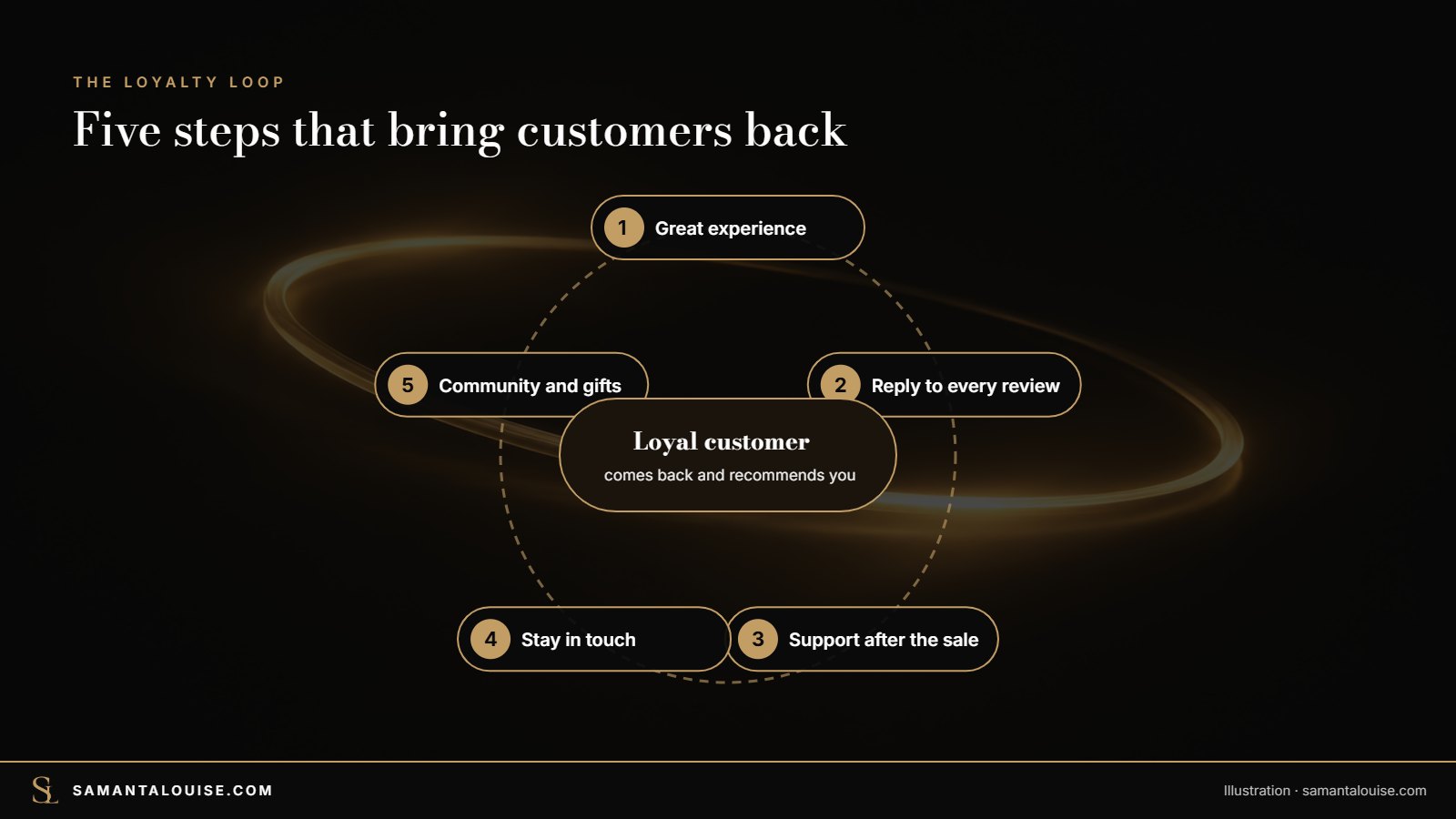
Customer loyalty means customers who come back and who recommend you to others. To build it, a small business in Mauritius needs five things: a great experience at every step, problems solved quickly and in public (including a reply to every Google review), real support after the sale, regular contact between purchases, and a loyalty program that makes customers feel part of a community, not just buyers from a random shop. Keeping a happy customer is far easier than convincing a stranger.
THE QUICK ANSWER
- Experience first: make every step easy, from the first reply to delivery.
- Fix problems in public: claim your Google Business Profile and reply to every review.
- Support after the sale, especially for expensive purchases.
- Stay in touch between purchases, with permission.
- Build a community, not just a points card: gifts, previews, recognition.
One warning: a loyalty card on its own is not loyalty. If customers have no reason to come back and never hear from you between visits, the card stays in a drawer. The rest of this guide shows why loyalty matters, how it works even when customers rarely buy, and the five steps in practice.
In my experience, many businesses try to focus on their social media posting without dealing with their customer experience. You could run an amazing campaign but if your current customers despise the experience they had with your business, it is going to affect you in the long term especially if they go telling people about it.
In this guide
Why keeping customers matters more than you think
As a marketing strategist, I see the same pattern again and again: businesses put almost all their energy into finding new customers, and almost none into the customers they already have. More ads, more posts, more promotions for strangers, while last month’s happy buyers never hear from them again.
That is expensive. In the Harvard Business Review, Amy Gallo summarised that acquiring a new customer can cost five to 25 times more than keeping an existing one, depending on the industry. She also cites Frederick Reichheld of Bain & Company: increasing customer retention by 5% increases profits by 25% to 95%.
| A new customer | A happy existing customer | |
|---|---|---|
| Knows your business? | No | Yes |
| Trusts you? | Not yet | Already |
| Cost to reach them | Ads, time, persuasion | A WhatsApp message |
| Likely to recommend you? | Not yet | Yes, if they were well treated |
This does not mean you stop looking for new customers. Every business needs them. It means you stop losing the ones you already won. To know which customers deserve the most attention, start with your ideal customer profile.
What if your customers rarely buy again?
Some businesses sell things people do not buy every month. A sofa, a dining table, a wedding dress, a car. A furniture customer may not need another sofa for years. Does loyalty still matter? Yes, for three reasons.
- The next time they need something similar, you should be their first thought, not a Google search. A new bedroom, a home for their children, an office.
- They buy related things. The sofa buyer may need a rug, curtains or a mattress next month.
- They talk. In Mauritius, a happy customer tells family, colleagues and neighbours. One loyal customer can bring several new ones.
| Type of business | How often people buy | What loyalty looks like |
|---|---|---|
| Café, bakery, salon | Weekly or monthly | Coming back often, trying new things |
| Clothing, beauty, gifts | A few times a year | Coming back each season, following you online |
| Furniture, cars, weddings, renovation | Every few years | Remembering you, buying related items, recommending you |
Check yours: When did you last contact a customer who bought from you more than six months ago?
Step 1: make the experience easy and pleasant
Customer satisfaction comes first, and it is built in small moments. Most customers do not leave because of the product. They leave because the reply was slow, the delivery date moved without a call, or nobody said thank you.
| Moment | What customers remember | What to do |
|---|---|---|
| First contact | How fast and how kindly you replied | Reply within minutes during opening hours |
| Buying | Clear prices, no surprises | Confirm the price, date and next step in writing |
| Delivery or service | Being on time, and told if not | Call before a delay, not after |
| After the sale | Whether you cared once they paid | Send a thank-you and check that all is well |
Check yours: Ask your last three customers: “What was the one thing we could have done better?”
Step 2: fix problems in public, starting with Google reviews
Many businesses leave their Google Business Profile unclaimed, with bad reviews and no replies. For a new customer, that is a warning sign. For the unhappy customer, it confirms that nobody cares.
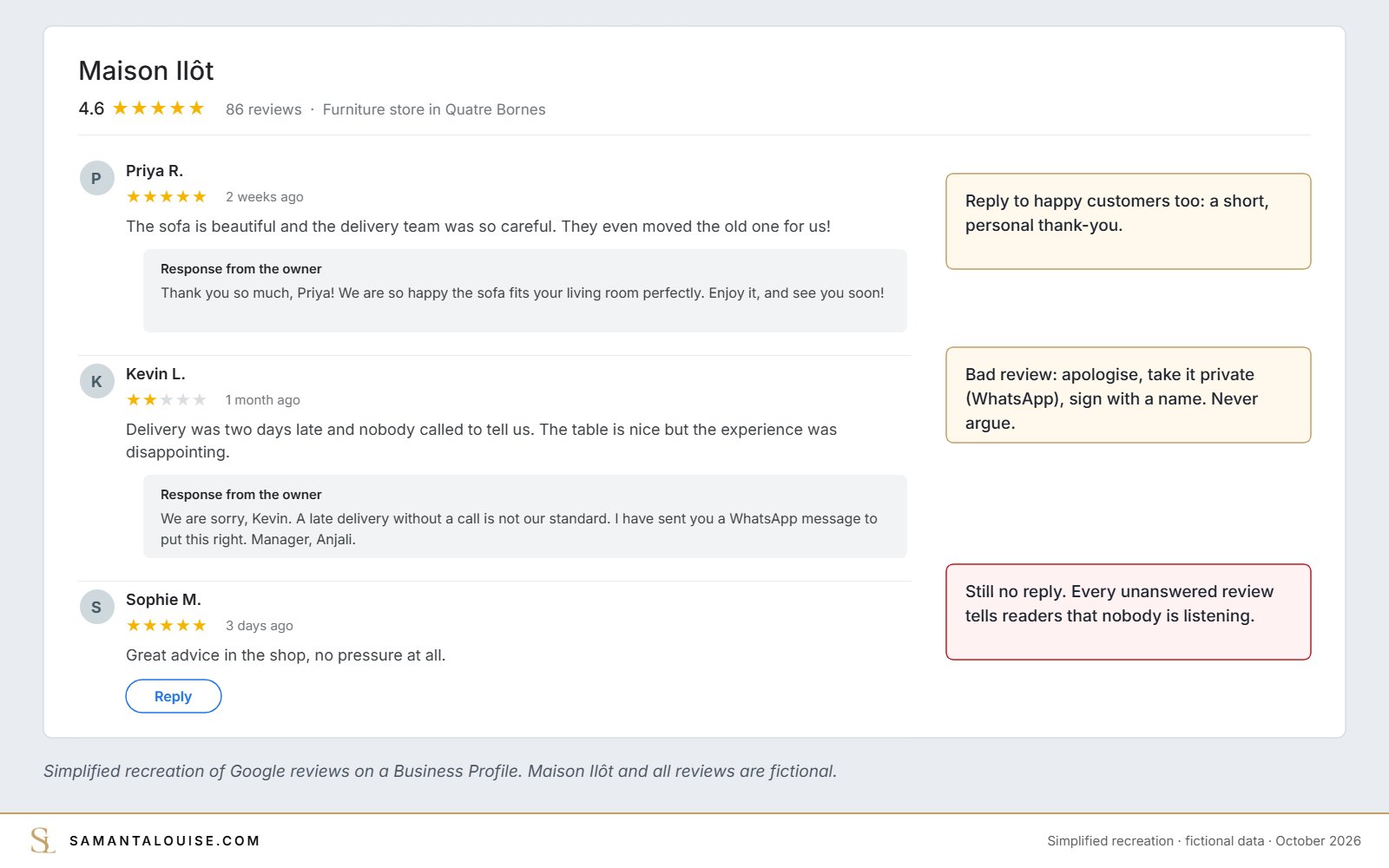
First, claim and verify your profile: Google says only verified businesses can reply to reviews. Then reply to every review, the good ones too. A thank-you to a happy customer shows everyone reading that you listen.
It also pays. Researchers Proserpio and Zervas studied tens of thousands of TripAdvisor hotel reviews and found that hotels that started replying received about 12% more reviews, and their average rating rose by 0.12 stars. Small, but ratings rarely move, and every reply is read by future customers.
Good review, English: “Thank you so much, Priya! We are so happy the sofa fits your living room perfectly. Enjoy it, and see you soon!”
Good review, French: “Merci beaucoup, Priya ! Nous sommes ravis que le canapé aille parfaitement dans votre salon. Profitez-en bien, et à très bientôt !”
Bad review, English: “We are sorry, Kevin. A delivery that is two days late without a call is not our standard. I have sent you a WhatsApp message to put this right. Manager, [name].”
Bad review, French: “Nous sommes désolés, Kevin. Une livraison avec deux jours de retard sans appel n’est pas notre standard. Je vous ai envoyé un message WhatsApp pour arranger cela. La gérante, [nom].”
Fictional examples. Adapt the names and details.
Step-by-step help: Google Business Profile for service businesses, Google My Business for shops and how to get more Google reviews.
Check yours: Open your Google Business Profile now. How many reviews have no reply?
Step 3: support customers after the sale
Once a customer has paid, the relationship starts, it does not end. This matters most for high-end, expensive purchases, where customers worry: did I choose well? What if something goes wrong?
Here is a simple aftercare plan for Maison Ilôt, a fictional furniture shop:
| When | Message or action |
|---|---|
| Day 2 after delivery | “Is everything as you hoped? Here is how to care for solid teak.” Send a short care guide. |
| Week 3 | “Any questions about your table? We are here.” |
| Month 6 | A free check-up or a care product as a thank-you |
| Month 11 | A reminder before the warranty ends |
| Anytime | A named person to call or WhatsApp, not a general number |
Quick replies and labels in WhatsApp Business make this easy, and a CRM can remind you when each message is due.
Step 4: stay in touch between purchases
Customers forget businesses that go silent. Stay in touch, with permission and with something useful to say, not just promotions.
- A birthday message, with a small gift for their next visit
- Early access to new collections or seasonal menus
- Useful tips about what they bought: care, recipes, styling
- An invitation to an event, a tasting or a workshop
- A thank-you when they recommend you to someone
Keep a list of customers with their WhatsApp number, what they bought and when, and their permission to be contacted. Then send something worth reading once or twice a month, not every day.
Step 5: a loyalty program that feels like a community
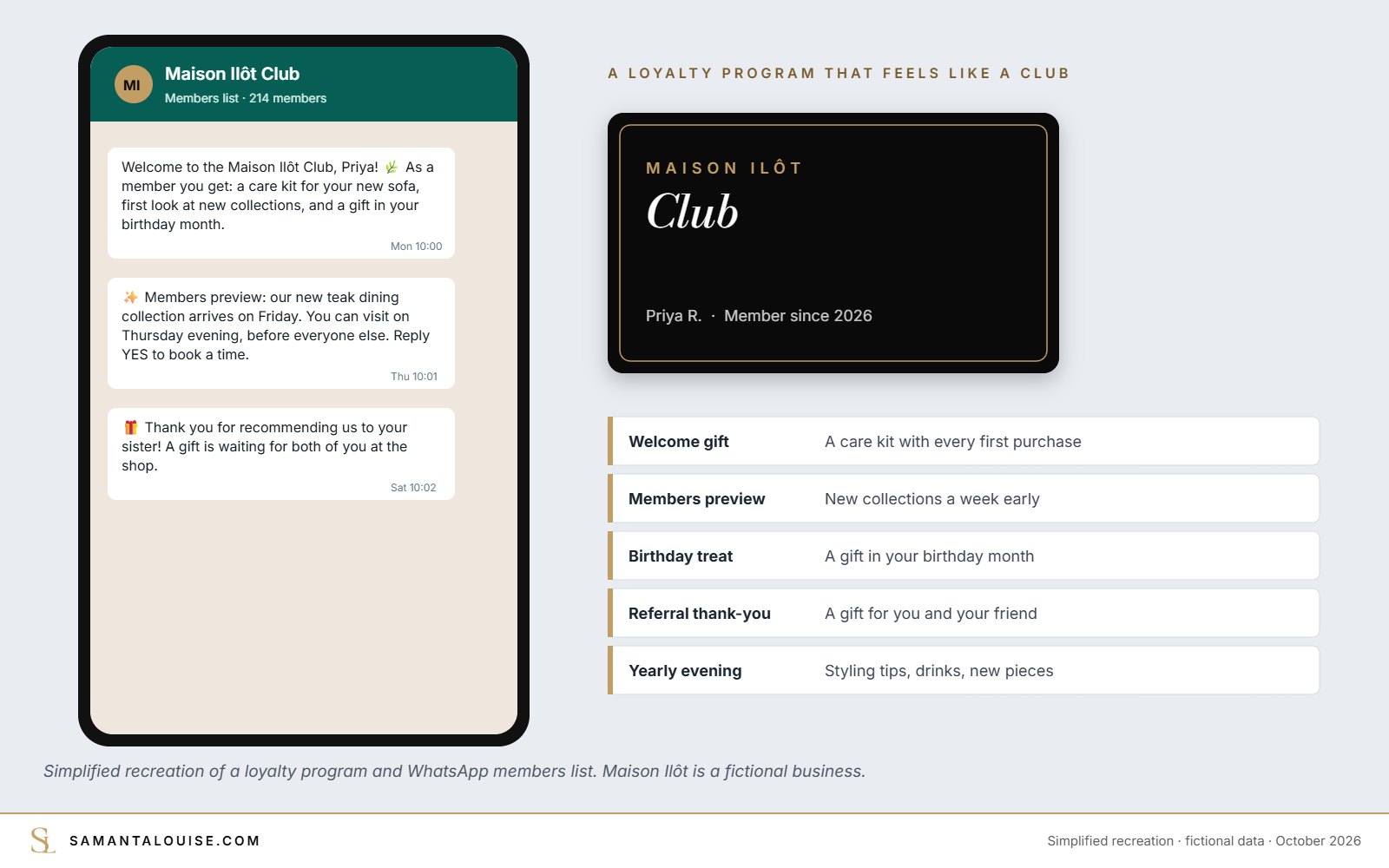
In Mauritius, a loyalty program works best when it makes people feel recognised and part of something, not when it only counts points. The goal is that customers feel they joined a community, not that they bought from a random business.
| Idea | Why it works | Example |
|---|---|---|
| Welcome gift | Starts the relationship warmly | A small gift with the second purchase |
| Members-only previews | People love being first | New collection shown to members a week early |
| Birthday treat | Personal, remembered | A free coffee or a 10% voucher in their birthday month |
| Referral thank-you | Rewards those who bring friends | A gift for both the customer and the friend |
| Events and workshops | Creates real community | A styling evening, a tasting, a care workshop |
| A VIP WhatsApp group or list | Direct, local, familiar | Members get news and invitations first |
Gifts and experiences often work better than discounts: a discount teaches people to wait for sales, while a gift makes them feel valued.
How to measure customer loyalty
You do not need software for this. Check four numbers every three months:
| Number | How to calculate it |
|---|---|
| Repeat customer rate | Customers who bought more than once ÷ all customers |
| Referrals | New customers who say a friend recommended you |
| Google rating and number of reviews | Read it on your Business Profile |
| Review reply rate | Reviews with a reply ÷ all reviews (aim for all of them) |
Why a loyalty program alone will not grow your sales
A loyalty program is a tool. The typical mistake is a stamp card with no reason to come back and no contact with the customer between visits. Picture a fictional café in Curepipe: it prints 500 loyalty cards, but its service is slow, its Google reviews have no replies, and it never messages anyone. The cards end up in wallets, unused.
A strategy starts earlier: who are your best customers, why do they leave, and what would bring them back? Loyalty belongs to the growth stage, and it only works when the experience before it is good. The growth stage of a marketing strategy and the five stages show how they connect.
Check yours: Of last year’s customers, how many bought from you again this year, and do you know why the others did not?
Frequently asked questions
What is customer loyalty?
Customer loyalty is when customers keep choosing your business over others, buy again and recommend you. It comes from good experiences, trust and a relationship that continues after the sale.
Why is customer retention cheaper than finding new customers?
Existing customers already know and trust you, so reaching them costs little. The Harvard Business Review reported that acquiring a new customer can cost five to 25 times more than keeping one.
How do I get repeat customers in Mauritius?
Make every step easy, reply to every review, support customers after the sale, stay in touch with useful messages, and reward them with gifts and recognition rather than only discounts.
Should I reply to good Google reviews too?
Yes. A short, personal thank-you shows future customers that you listen, and Google says helpful replies show you are responsive.
Does customer loyalty matter if people only buy once every few years?
Yes. They will remember you when they need something similar, buy related items and recommend you to others.
What is a good loyalty program for a small business?
One that makes customers feel recognised: a welcome gift, members-only previews, a birthday treat, a referral thank-you and occasional events.
Start with the customers you already have
This week: reply to every unanswered Google review, send a thank-you message to your last ten customers, and write down one small gift or privilege you could offer your best customers.
Not sure whether loyalty is your weakest stage, or whether customers are lost earlier? The free Market Dominator Scorecard shows it in a few minutes. To see how loyalty fits the bigger picture, read the marketing strategy guide for small businesses in Mauritius.
Which of your customers would you most like to see again this month, and what will you send them?