Ideal Customer Profile: How to Define Yours (With a Mauritian Example)
An ideal customer profile (ICP) is a short description of the customers who bring you the most profit with the least effort, and who come back and recommend you. To define yours, list your last 50 sales, score each customer on four questions (profitable, easy to serve, came back, sent someone), and look at what the top scorers have in common: who they are, what they buy, why they chose you and where they found you. Write it in five lines. Then change your offer, channels and messages for them.
Based on my experience as marketing strategist, it is not easy to target your Ideal customers but once you identify them, resonate with them and manage to have them as 40% of your customer base, your business will keep thriving in the long term. The idea is to have them feed your visibility phase through recommendations.
THE QUICK ANSWER
- What it is: a description of your best customers, not of everyone who might buy.
- Where it comes from: your last 50 sales, not your imagination.
- How to score: profitable, easy to serve, came back, sent someone.
- How to write it: who, what they buy, why you, where they find you, what they worry about.
- How to use it: change your offer, channels and messages for them.
Most businesses that write a customer profile put it in a drawer. The profile only pays when it changes what you sell, where you show up and what you say. The rest of this guide shows how to find yours from real sales, a worked Mauritian example, and how to put it to work.
In this guide
Ideal customer profile vs target audience vs buyer persona
Three terms get mixed up. They are related, but they answer different questions.
| Term | The question it answers | Example for a curtain workshop |
|---|---|---|
| Target audience | Who could buy from us? | Households in Mauritius who need curtains or blinds |
| Ideal customer profile | Who are our best customers? | Couples moving into a newly built house who want every room done and fitted on time |
| Buyer persona | What does one typical best customer think and feel? | “Priya, 42, moving into her new house in Moka in March, worried about delays” |
The target audience is wide. The ideal customer profile is narrow on purpose: it tells you who to put first. A persona is optional; it simply gives your ICP a face so your team remembers it.
Why an ideal customer profile matters in a small market
Mauritius is small. DataReportal’s Digital 2026 report for Mauritius put Facebook’s ad reach at 886,000 people. Your competitors can reach the same people you can. You will not win by shouting at everyone; you win by being the obvious choice for one group.
It also matters for profit. Customers are not equally valuable. Writing for Harvard Business School, Robert Kaplan explained that in customer profitability studies, 15 to 20 percent of customers typically generate 100 percent or more of the profits, while others cost more to serve than they bring in. If you know which customers those are, you can find more of them.
One balancing point. Marketing scientist Byron Sharp’s research, summarised here by ThinkTV, found that a brand’s heaviest fifth of buyers produces only about half of its sales. So an ICP is a priority, not a fence. You still welcome everyone who walks in. You simply design your offer and messages around your best customers first.
How to find your ideal customer profile from your last 50 sales
Do not start with a blank page and guess. Start with what already happened. You need about an hour, your sales records (invoices, a notebook, WhatsApp chats or your CRM) and a spreadsheet.
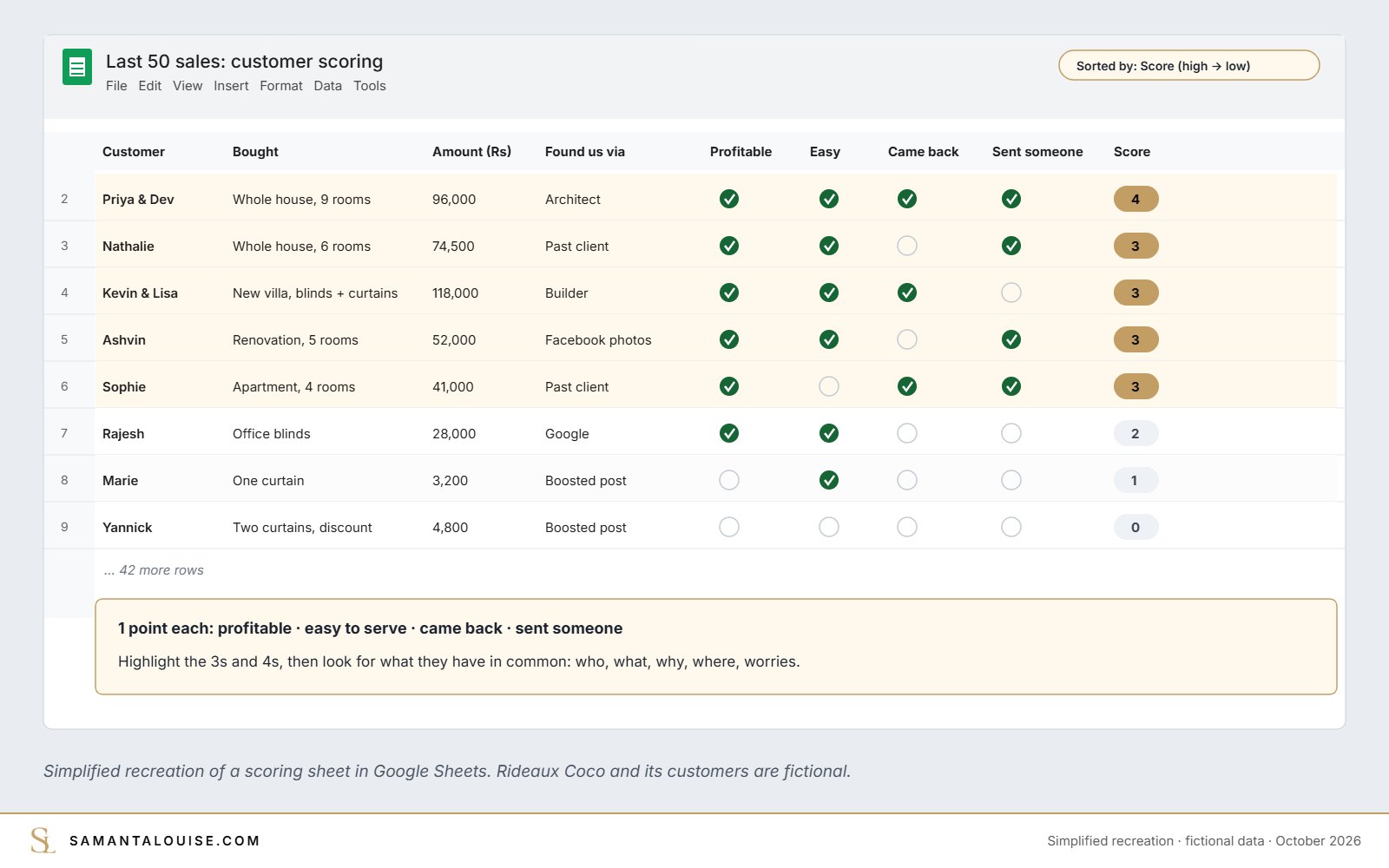
- List your last 50 customers. Name, what they bought, how much, and how they found you. Fewer than 50? Use all of them.
- Score each one on four questions, 1 point for each yes (see the table below).
- Sort by score. Customers with 3 or 4 points are your best customers.
- Look for patterns among the top scorers: age or life stage, area, type of business, what they bought, why they chose you, where they found you.
- Write the profile in five lines using the template further down.
- Ask three of them why they chose you. A short call or WhatsApp message. Their words become your marketing messages.
| Question | Give 1 point if | Why it matters |
|---|---|---|
| Profitable? | Your margin on this customer was above your average | Some customers cost more than they bring |
| Easy to serve? | Paid on time, few changes, no long negotiation | Hard customers eat your time |
| Came back? | Bought more than once | Repeat buyers cost nothing to win again |
| Sent someone? | Referred a friend, family member or colleague | Your best customers bring others like them |
Check yours: Which of your last ten customers would you happily clone? What do they have in common?
A worked example: a curtain workshop in Quatre Bornes
Rideaux Coco is a fictional made-to-measure curtain and blinds workshop in Quatre Bornes. The numbers are illustrative. The owner scored her last 50 sales. Eleven customers scored 3 or 4 points, and they looked remarkably alike.
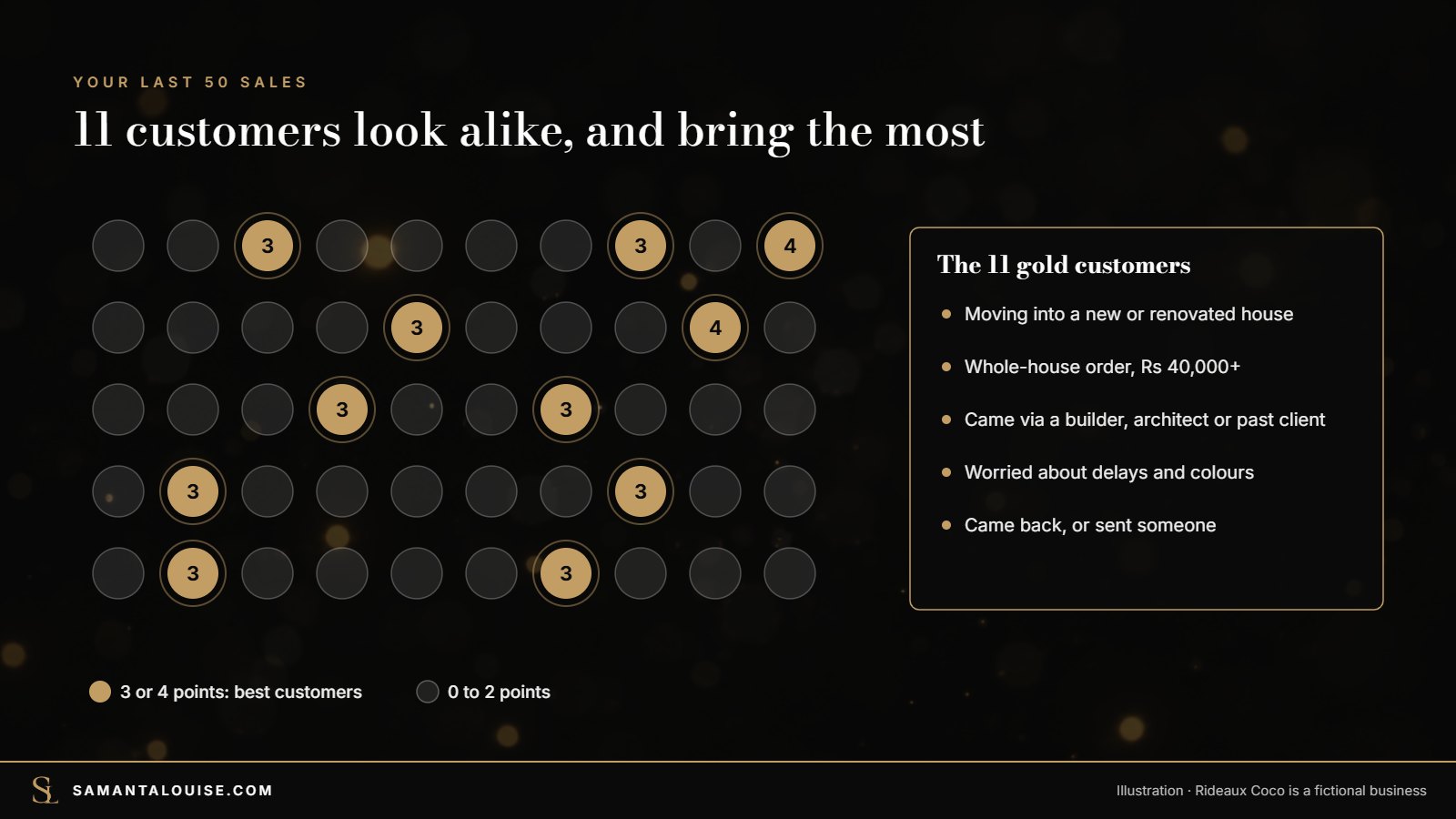
| Top 11 customers (3 to 4 points) | Lowest scorers (0 to 1 point) | |
|---|---|---|
| Who | Couples aged 35 to 55 moving into a newly built or renovated house | People replacing one curtain |
| What they bought | Curtains and blinds for the whole house, Rs 40,000 to Rs 120,000 | One item, under Rs 5,000 |
| Why they chose her | Made to measure, fitted before moving in, one person for everything | Lowest price after a discount |
| Where they found her | Their builder or architect, a past client, Facebook photos of finished homes | A boosted promotion post |
| What they worried about | Delays, colours not matching, being overcharged | Price only |
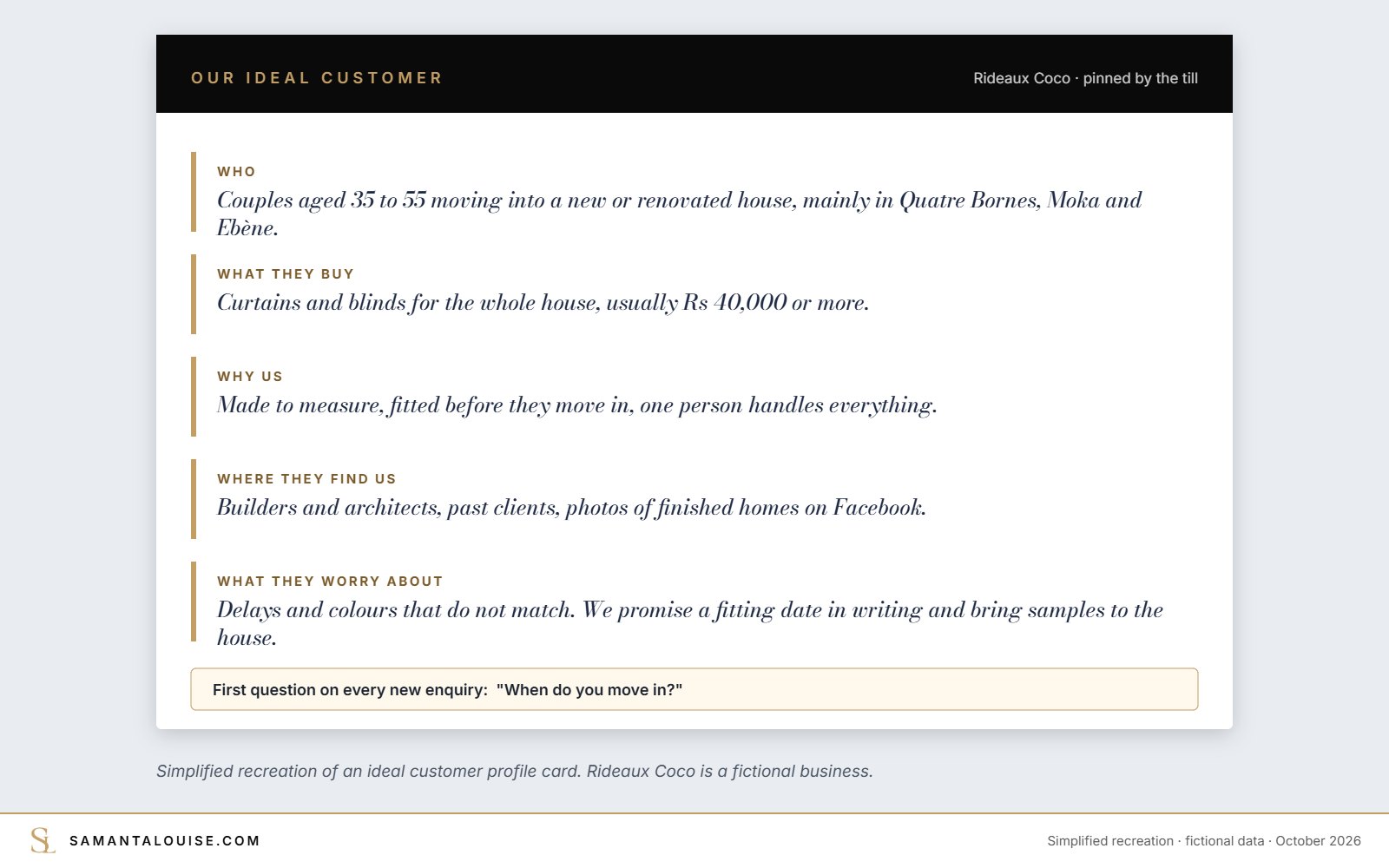
Her ideal customer profile, in five lines:
Who: couples aged 35 to 55 moving into a new or renovated house, mainly in Quatre Bornes, Moka and Ebène.
What they buy: curtains and blinds for the whole house, usually Rs 40,000 or more.
Why us: made to measure, fitted before they move in, one person handles everything.
Where they find us: builders and architects, past clients, photos of finished homes on Facebook.
What they worry about: delays and colours that do not match, so we promise a fitting date in writing and bring fabric samples to the house.
Rideaux Coco, fictional example
Write your ideal customer profile in five lines
Copy this and fill in the brackets. Write it in the language your team uses every day.
English: Our best customers are [who] who need [what] because [why]. They find us through [where]. They worry about [fear], so we [promise].
Français : Nos meilleurs clients sont [qui] qui ont besoin de [quoi] parce que [pourquoi]. Ils nous trouvent via [où]. Ils craignent [peur], alors nous [promesse].
Check yours: Could a new member of your team read your five lines and know which enquiry to answer first?
How to use your ICP: change the offer, channels and messages
This is where most profiles stop, and where yours should start working. Here is what Rideaux Coco changed:
| Before | After, built for the ICP | |
|---|---|---|
| Offer | “Curtains from Rs 1,500” | “Whole-house package: measured, made and fitted before you move in” |
| Channels | Boosted promotion posts | Partnerships with three builders and architects, Facebook ads showing finished homes, a thank-you gift for referrals |
| Message | “Best prices in town!” | “Moving in next month? Your curtains, fitted on time.” |
| WhatsApp first reply | “Price depends on size.” | “Congratulations on the new house! When do you move in? I can come and measure this week.” |
For the ads, a clear ICP also makes your budget go further, because your photos and words speak to one person. See how much Facebook ads cost in Mauritius. For the first reply, set up quick replies in WhatsApp Business.
Why an ideal customer profile alone will not grow your sales
Defining your customer is the first step of a strategy, not the whole of it. The common trap is to write a beautiful profile and then carry on exactly as before: the same offer, the same posts, the same “price on request” reply.
Picture a fictional fitness studio in Rose-Hill. Its profile says “working mothers aged 30 to 45 who want to get back in shape”. Its posts still show bodybuilders and protein shakes, its classes are at 6 p.m. when school pick-up ends, and its offer is a 12-month contract. The profile is right; nothing else changed, so nothing improved.
The ICP answers who. A strategy then decides what to fix first for them: are they not seeing you (visibility), not believing you (trust), or not buying when they enquire (conversion)? The priority customer stage of a marketing strategy shows how this first stage feeds the other four, and the five stages show the order.
Check yours: Name one thing you sell, one place you advertise and one message you use that you would change for your best customer.
Frequently asked questions
What is an ideal customer profile?
A short description of the customers who bring a business the most profit with the least effort, and who come back and recommend it. It covers who they are, what they buy, why they choose you, where they find you and what they worry about.
What is the difference between an ideal customer profile and a target audience?
A target audience is everyone who could buy from you. An ideal customer profile is the smaller group of your best customers, the ones you design your offer and messages around first.
Is an ideal customer profile the same as a buyer persona?
Not quite. The ideal customer profile describes a group of best customers. A buyer persona is an imagined individual from that group, with a name and a story, to help your team picture them.
How many ideal customer profiles should a small business have?
Start with one. A second profile only makes sense when you have enough budget and time to give it its own offer and messages.
Is an ideal customer profile only for B2B companies?
No. The term comes from business-to-business sales, but the method works for any business with customer records, from a curtain workshop to a beauty salon.
What if my business is new and has few sales?
Use what you have: your best ten conversations, the reviews competitors receive, and the questions people ask you. Write a first profile, then update it after your first 50 sales.
Start with your last 50 sales
This week: export or write down your last 50 customers, score them on the four questions, and write your five lines. It takes about an hour, and it will sharpen every post, ad and reply after it.
Once you know who your best customer is, the next question is where you are losing them. The free Market Dominator Scorecard shows your weakest stage in a few minutes. To see how the stages connect, read the marketing strategy guide for small businesses in Mauritius.
Who is the one customer you wish you had ten more of?