Free One-Page Marketing Plan Template for Small Businesses in Mauritius (With Example)
A marketing plan template for a small business should fit on one page. It answers nine questions: your goal for the next 90 days, your priority customer, your weakest stage, your offer, your one or two channels, your monthly budget, your actions month by month, the numbers you will track, and when you will review it. You can get the template below for free, see it filled in for a fictional Mauritian business, and complete your own in about 30 minutes.
THE QUICK ANSWER
- One page, nine boxes: goal, customer, weakest stage, offer, channels, budget, actions, numbers, review date.
- 90 days, one goal: one number you can count, with a date.
- Two channels at most, chosen for where your customer already is.
- Fix the weakest stage first, before adding anything new.
- Review it once a month and change what is not working.
One warning before you start. A template is only as good as the diagnosis behind it. If you fill in every box without knowing which stage of your marketing is weakest, the plan will look complete and fix nothing. The rest of this guide shows each box, a filled-in example and how to avoid that trap.
In this guide
Why a one-page marketing plan works for small businesses
Most small business owners in Mauritius do not need a 30-page marketing plan. They need a page they will actually read on a Monday morning. A one-page plan forces you to choose: one goal, one customer, two channels. Choosing is the hard part, and it is the part that makes the plan work.
Planning does pay. A meta-analysis of studies on small firms by Brinckmann, Grichnik and Kapsa found that business planning is generally good for performance, and that the effect depends on how new the firm is and on its environment. Their advice is to plan and learn at the same time, adjusting the plan as results come in. That is exactly what a short plan with a monthly review does.
Writing the plan down also matters. In a 2022 survey of 515 marketers by CoSchedule, those who documented their strategy were far more likely to report success. It is a self-selected survey and shows a link, not proof, but it matches what I see with clients: a plan in writing gets done; a plan in your head gets postponed.
| Long marketing plan | One-page marketing plan |
|---|---|
| Written once, then filed away | Kept on the desk and reviewed every month |
| Tries to cover every channel | Two channels, chosen on purpose |
| Goals like “grow the brand” | One number with a deadline |
| Takes weeks to write | Takes about 30 minutes |
| Hard to share with staff | Easy to pin up and discuss with the team |
The free one-page marketing plan template: 9 boxes
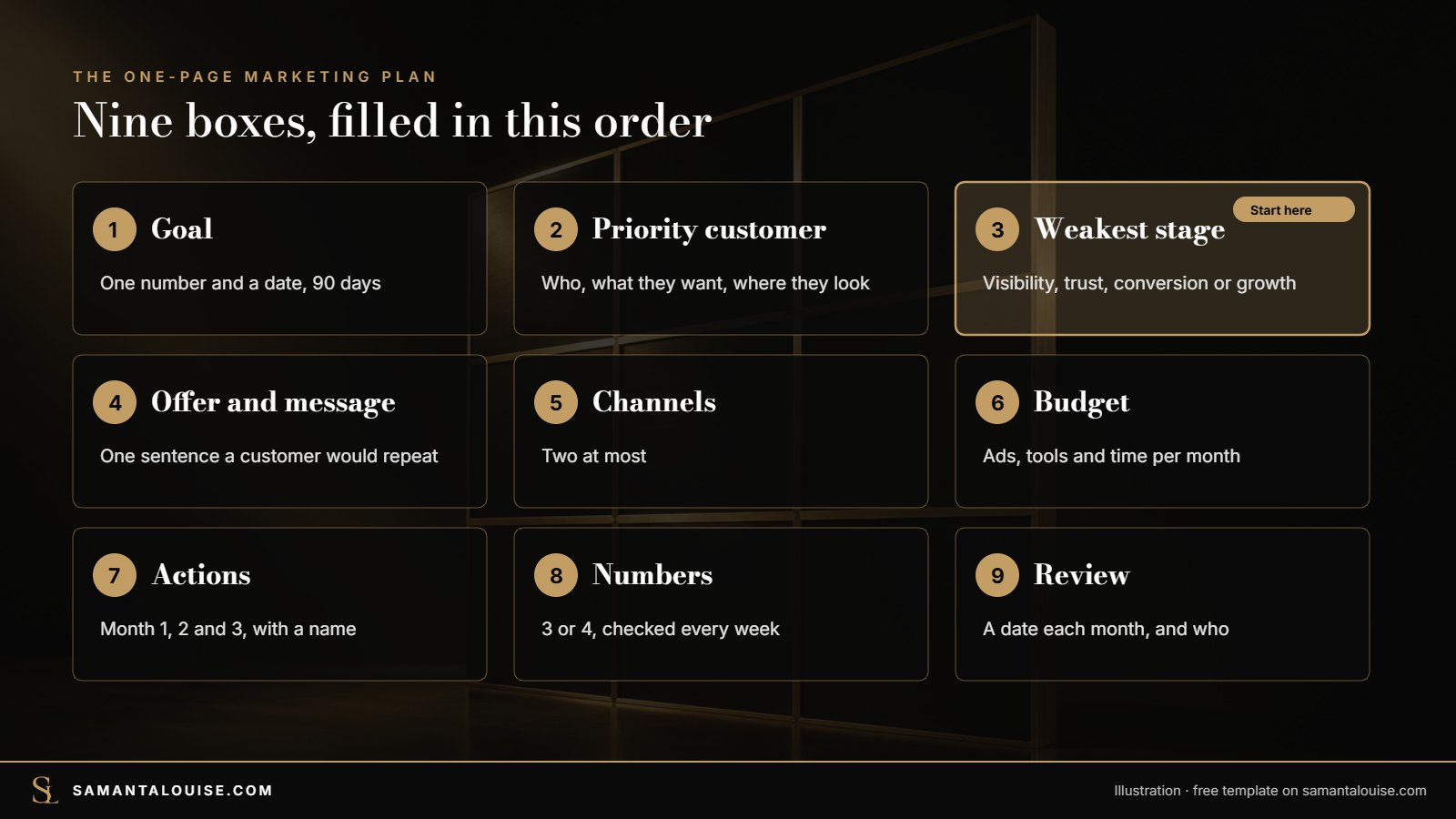
Here are the nine boxes and the question each one answers. Fill them in order: each box depends on the one before.
| Box | The question | A good answer looks like |
|---|---|---|
| 1. Goal | What one result do I want in the next 90 days? | A number and a date: “15 new customers by 31 January” |
| 2. Priority customer | Who am I selling to first? | Who they are, what they want, where they look for it |
| 3. Weakest stage | Where am I losing the most customers? | One of: visibility, trust, conversion, growth |
| 4. Offer and message | Why should they choose me now? | One sentence a customer would repeat to a friend |
| 5. Channels | Where will they see and contact me? | Two channels at most, plus where enquiries arrive |
| 6. Budget | How much will I spend each month? | Ads, tools and time, in rupees and hours |
| 7. Actions | What will I do in month 1, 2 and 3? | 2 or 3 actions per month, each with a name next to it |
| 8. Numbers | How will I know it is working? | 3 or 4 numbers checked every week |
| 9. Review | When will I check and adjust? | A date each month and the person responsible |
A word on box 1. Decades of goal-setting research by Locke and Latham show that specific, challenging goals lead to better performance than vague ones such as “do your best”. “Get more customers” is not a goal. “15 new customers by 31 January” is.
Check yours: Can you write your goal as one number and one date? If not, start there before anything else.
A marketing plan example: a wellness studio in Curepipe
Here is the template filled in for Kaz Zen, a fictional wellness studio in Curepipe. The numbers are illustrative, not real client data. Kaz Zen gets enquiries on WhatsApp from its Facebook and Instagram posts, but many never book a first class.
| Box | Kaz Zen’s answer |
|---|---|
| 1. Goal | 20 new monthly-pass clients by 31 January 2027 |
| 2. Priority customer | Working women aged 30 to 45 in Curepipe and Floréal who want to relieve stress after work. They scroll Facebook and Instagram in the evening and ask friends for recommendations. |
| 3. Weakest stage | Conversion. Enquiries arrive on WhatsApp, but replies take hours and nobody follows up. |
| 4. Offer and message | “Your first class is free. One hour, ten minutes from the office, and you leave lighter.” |
| 5. Channels | Facebook and Instagram ads that open WhatsApp, plus the Google Business Profile for people who search nearby |
| 6. Budget | Rs 4,000 a month in ads (Rs 1,000 a week), WhatsApp Business (free), 3 hours a week of the owner’s time |
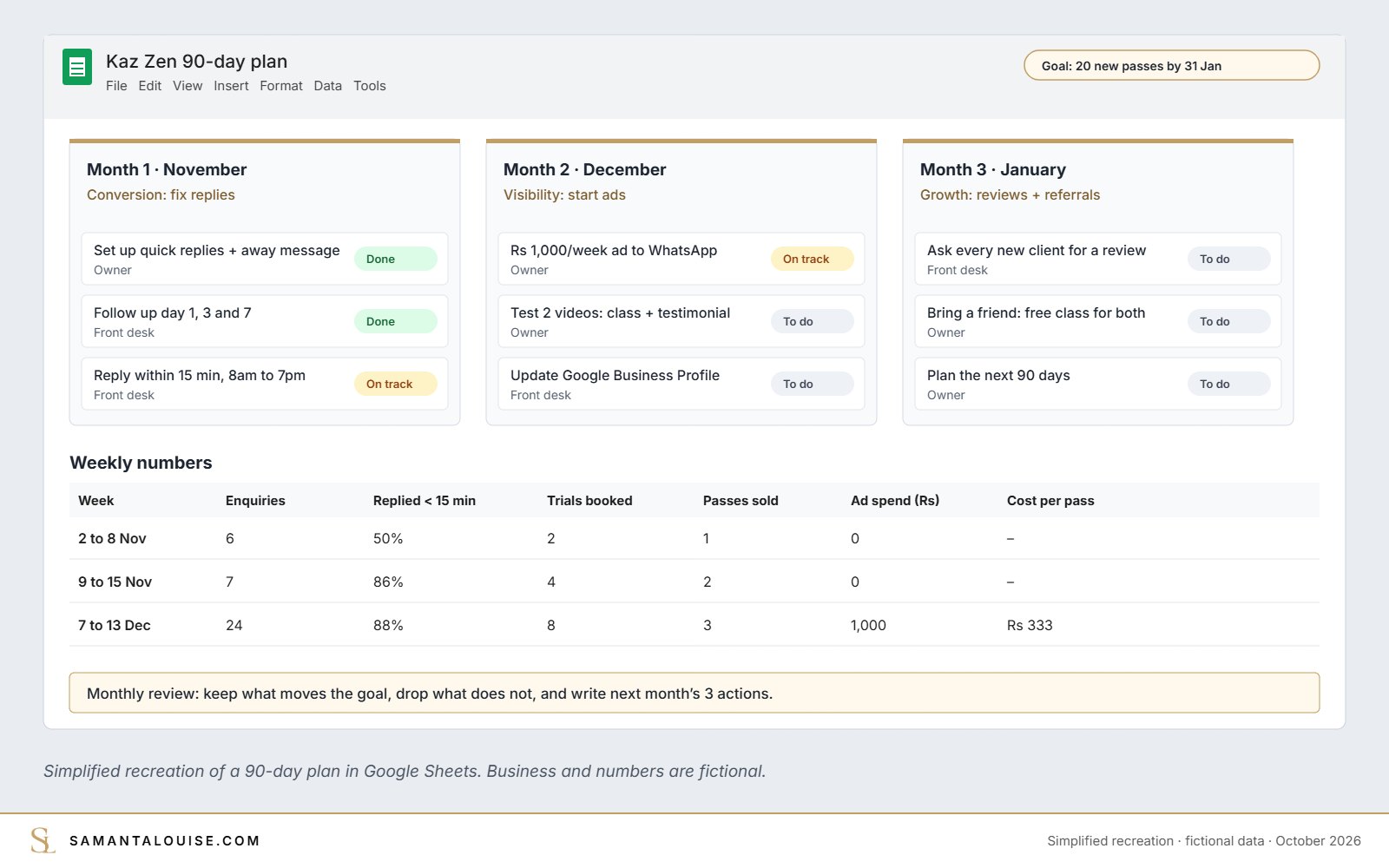
| 7. Actions | Month 1: fix replies and follow-up. Month 2: start ads. Month 3: ask every new client for a review and a referral. |
| 8. Numbers | Enquiries per week, % answered within 15 minutes, first classes booked, passes sold, cost per new client |
| 9. Review | Last Friday of each month, 30 minutes, the owner and the front-desk manager |
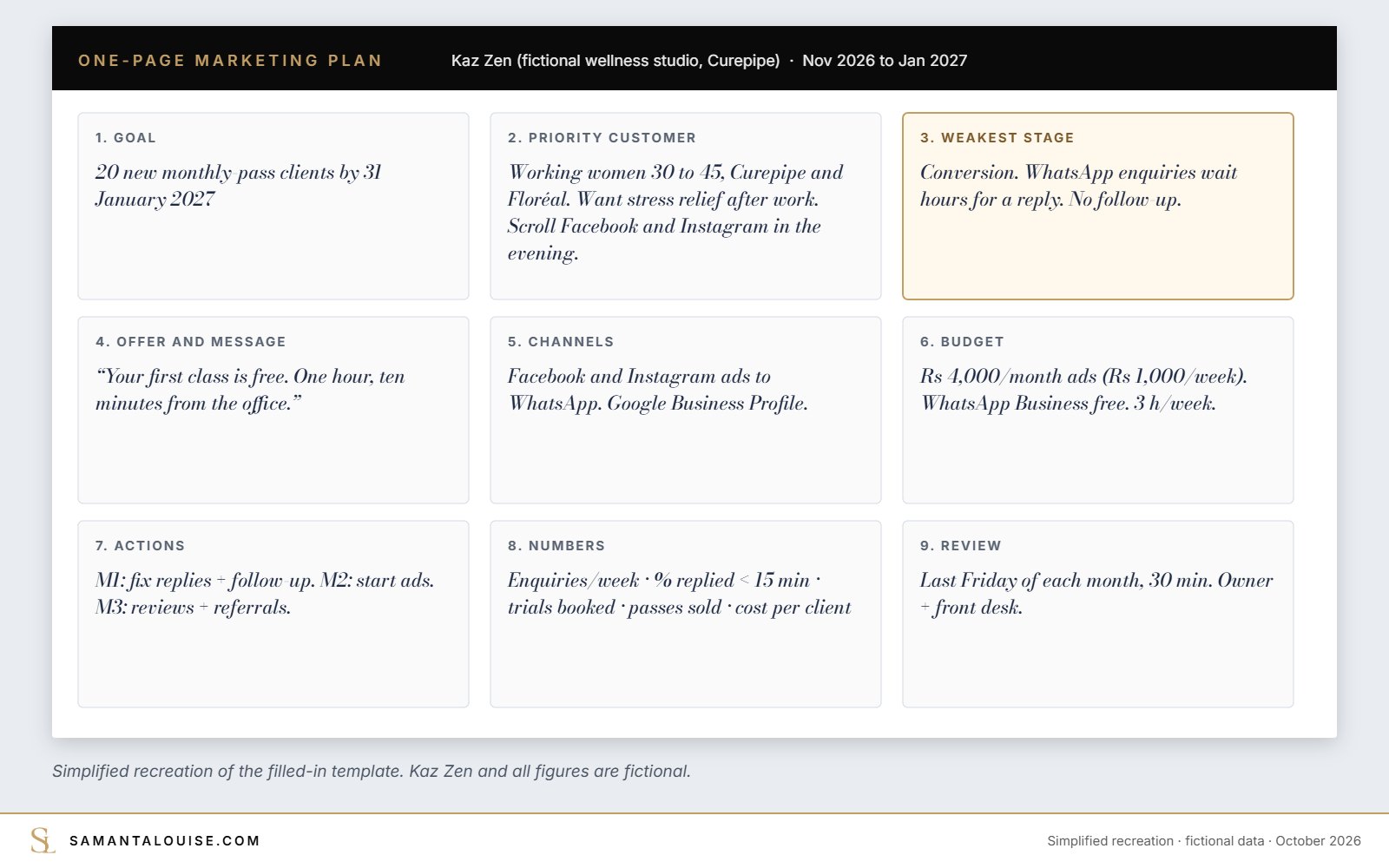
Notice the order of the actions. Kaz Zen’s weakest stage is conversion, so month 1 fixes replies and follow-up before a single rupee goes into ads. For the reply set-up, see the WhatsApp Business guide. For the ad budget, see how much Facebook ads cost in Mauritius; Rs 1,000 a week is the minimum I recommend to start seeing results.
How did Kaz Zen arrive at Rs 4,000? By working backwards from the goal, as explained in the marketing budget guide: in my campaigns a WhatsApp enquiry has cost about Rs 15, so 20 clients at around 10 enquiries each needs about Rs 3,000 of ads. The plan adds a margin for testing.
How to fill in your marketing plan in 30 minutes
- Minutes 0 to 5, the goal. Look at last quarter’s sales. Write one number you want to reach in 90 days, and the date.
- Minutes 5 to 10, the customer. Picture your three best customers. What do they have in common? Write who they are, what they want and where they look for it.
- Minutes 10 to 15, the weakest stage. Ask: do enough of the right people know us (visibility)? Do they believe us (trust)? Do enquiries turn into sales (conversion)? Do customers come back (growth)? The free Market Dominator Scorecard answers this for you in a few minutes.
- Minutes 15 to 20, offer and channels. Write one sentence of offer. Pick at most two channels where your customer already spends time.
- Minutes 20 to 25, budget and actions. Write the monthly budget in rupees and hours. Then two or three actions per month, starting with the weakest stage, each with a name next to it.
- Minutes 25 to 30, numbers and review. Choose three or four numbers to check every week, and put the first review date in your calendar now.
Check yours: Does every action in your plan have a person’s name and a month next to it?
Common marketing plan mistakes, and how to fix them
| Mistake | What happens | The fix |
|---|---|---|
| Five goals at once | Nothing gets finished | One goal for 90 days |
| Every channel “to be safe” | Small budget spread too thin | Two channels, done well |
| No budget written down | Ads stop and start with cash flow | A monthly amount you can keep for 3 months |
| Actions with no owner | Everyone thinks someone else is doing it | A name next to every action |
| Never reviewed | The plan is forgotten by week three | A monthly review date in the calendar |
| Copying a competitor | Their plan solves their problem, not yours | Start from your own weakest stage |
Why a marketing plan template alone will not grow your sales
A template is a form. It organises your thinking, but it cannot do the thinking for you. The most common mistake is to fill in every box with what you already do, and call it a plan.
Picture a fictional bakery in Rose-Hill. Its plan says: post every day on Instagram, boost two posts a month, run a promotion at the end of the year. Every box is filled. But the real problem is that half the phone and WhatsApp orders are missed during the morning rush. More posts bring more orders that nobody answers. The plan looks complete and fixes nothing.
A strategy starts one step earlier: find your weakest stage first, then let the plan serve that stage. The template is the tool; the diagnosis is the strategy. The five stages of a small-business marketing strategy show how the stages connect, and the planning section of the guide shows how budget fits in.
Check yours: Can you say, in one sentence, which stage of your marketing is losing you the most customers today?
Frequently asked questions
What should a small business marketing plan include?
A goal for the next 90 days, your priority customer, your weakest stage, your offer, one or two channels, a monthly budget, actions for each month, the numbers you will track, and a review date. All of it can fit on one page.
Is a one-page marketing plan enough?
For most small businesses, yes. A short plan that you review every month is more useful than a long document that nobody reads. You can add detail later if the business grows.
How long should a marketing plan cover?
Ninety days is a good period for a small business: long enough to see results, short enough to adjust. Review it every month and write a new one each quarter.
How much should I budget for marketing?
Work backwards from your goal: how many customers you want, how many enquiries it takes to win one, and what an enquiry costs. The marketing budget guide on this site shows the method step by step.
Can I use this marketing plan template for free?
Yes. The one-page template is free to print and use for your own business. Fill in the short form and it is sent to your email.
What is the difference between a marketing plan and a marketing strategy?
The strategy decides what to fix first and for whom. The plan turns that decision into actions, a budget and dates. A plan without a strategy keeps you busy without growing sales.
Fill in box 3 first
Get the template, block 30 minutes this week, and start with the box most people skip: your weakest stage. Everything else in the plan depends on it.
The free Market Dominator Scorecard tells you which stage is weakest in a few minutes, so you can write box 3 with confidence. If you want to understand how the stages fit together, read the marketing strategy guide for small businesses in Mauritius.
If you could change only one number in your business in the next 90 days, which would it be?
Sources
- Brinckmann, J., Grichnik, D. and Kapsa, D. (2010). Should entrepreneurs plan or just storm the castle? A meta-analysis on contextual factors impacting the business planning–performance relationship in small firms. Journal of Business Venturing, 25(1), 24–40
- Locke, E. A. and Latham, G. P. (2002). Building a practically useful theory of goal setting and task motivation: a 35-year odyssey. American Psychologist, 57(9), 705–717
- CoSchedule (2022). Marketing Strategy Trend Report, survey of 515 marketers